various types of eyelid lesions, some of which can be observed while others need to be removed. Although eyelid lesions that appear benign are usually benign, a biopsy is often indicated in order to make sure there is an accurate diagnosis. There are dozens of different types of eyelid lesions that can occur around the eyelid, the most common include skin cancer (such as basal cell carcinoma, squamous cell carcinoma, sebaceous cell carcinoma), benign lesions such as cysts, moles (also termed nevi), cholesterol deposits (also termed xanthelasma), skin tags, hemangiomas, papillomas, syringomas, chalazions or styes, actinic keratosis, and seborrheic keratosis.
Treatments Xanthelasma NYC New York NY
Your xanthelasma usually won't go away on its own. The growths will either stay the same size or get bigger over time.
If you're worried about your appearance, you may want to have these growths taken off. Your doctor can remove xanthelasma with one of these methods:
Dissolve the growth with medicine such as bichloroacetic acid or trichloroacetic acid
Freeze it off with intense cold (cryosurgery)
Remove it with a laser
Take it off with surgery
Treat it with an electric needle (electrodessication)
These treatments work well, but they can cause side effects such as scars, skin color changes, and a turning out of the eyelid. The growths can also come back, especially if you have inherited high cholesterol.
If you're worried about your appearance, you may want to have these growths taken off. Your doctor can remove xanthelasma with one of these methods:
Dissolve the growth with medicine such as bichloroacetic acid or trichloroacetic acid
Freeze it off with intense cold (cryosurgery)
Remove it with a laser
Take it off with surgery
Treat it with an electric needle (electrodessication)
These treatments work well, but they can cause side effects such as scars, skin color changes, and a turning out of the eyelid. The growths can also come back, especially if you have inherited high cholesterol.

Xanthelasma on eyelids treated with TCA Peels NYC New York NY
In my experience, I have found excision to benefit patients with xanthelasma for long term removal and reduction of recurrence. Peels, lasers, and dermabraision of these lesions rarely provide for permanent reduction or removal. Even with surgery, these will quite often have a small area of recurrence.
Seek the expert advice of a Board Certified Dermatologist before embarking on treatment of these troublesome lesions.
Xanthomas of the eyelids NYC New York NY
Xanthomas of the eyelids occur in patients with high cholesterol levels. They can simply be excised and removed by themselves,or at the same time as a blepharoplasty. It's best to get cholesterol levels checked prior to undergoing excision since they can return
Is This Severe Milia or Cholesterol Deposit Around the Eyes? NYC New York NY
These look like cholesterol deposits, known as xanthelasma. Surgical excision is the treatment. New xanthelasma can grow.
Xanthelasma treatment and recurrence nyc new york ny
Early hyfrecation treatment may minimize progression of recurrent xanthelasma. I have a large series of patients who have had long term success with combination treatment.
Xanthelasma treatment and recurrence nyc new york ny
Early hyfrecation treatment may minimize progression of recurrent xanthelasma. I have a large series of patients who have had long term success with combination treatment.
Xanthelasma (212)-644-9494 New York, NY
Xanthelasma
Synonym:
Xanthelasma palpebrarum
Periocular xanthoma
Periocular xanthoma
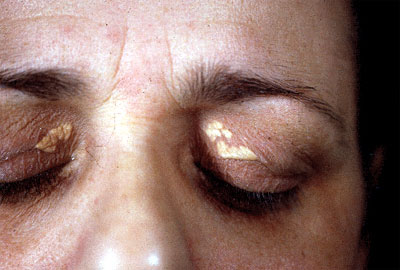
Xanthelasma is a soft, superficial, yellow-orange papule, most common on the medial upper eyelid.
Usually multiple and often symmetrical in distribution, lesions can occur in normolipemic individuals. However, they are of considerable value in identifying hyperlipemic patients at risk for occlusive vascular disease. Patients with xanthelasma should have a lipid profile determination.
Usually multiple and often symmetrical in distribution, lesions can occur in normolipemic individuals. However, they are of considerable value in identifying hyperlipemic patients at risk for occlusive vascular disease. Patients with xanthelasma should have a lipid profile determination.
Treatment:
- Lesions respond to surgical excision.
- Lesions also respond to the careful topical application of 40% trichloroacetic acid solution.
Subscribe to:
Comments (Atom)